

MOTS-c Explained: The Energy Peptide Built for Longevity

There is a growing category of research peptides that sits at the intersection of energy metabolism and longevity science. MOTS-c is one of the most compelling compounds in that space, and one of the least covered in the Canadian market despite a research profile that has been building steadily since its discovery just over a decade ago. For researchers interested in mitochondrial function, metabolic health, and the biology of aging, it represents one of the more genuinely interesting compounds currently available to study.
This piece covers what MOTS-c is, what the research shows about its primary areas of activity, and why it is attracting increasing attention from researchers working in longevity and metabolic health protocols.
What Makes MOTS-c Unusual
Most research peptides are synthetically engineered or derived from proteins found in human tissue. MOTS-c is different in a fundamental way: it is encoded by mitochondrial DNA rather than nuclear DNA. That distinction matters because it means MOTS-c is not a foreign signal introduced into a biological system. It is a naturally occurring peptide that the body produces itself, with endogenous levels that respond to exercise, metabolic stress, and age.
The significance of that origin becomes clearer when you consider what mitochondria actually do. Beyond their well-known role in energy production, mitochondria function as cellular sensors, monitoring metabolic state, responding to stress, and communicating with the nucleus and other cellular systems to coordinate the body’s response. MOTS-c is part of that communication system. It is a mitochondrial signal that travels beyond the mitochondria themselves, influencing metabolic processes at a systemic level.
One of the most relevant findings in the MOTS-c research base is that circulating levels of the peptide decline with age. That decline tracks closely with the kinds of metabolic and physical changes associated with aging, reduced insulin sensitivity, declining exercise capacity, increased fat accumulation, and impaired cellular stress response. Whether that relationship is causal or correlative remains an active research question, but it is the foundation for much of the current interest in MOTS-c as a longevity-relevant compound.
Energy Metabolism and Insulin Sensitivity
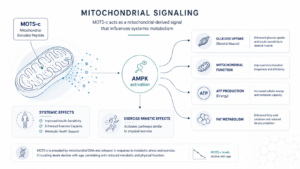 The most thoroughly studied area of MOTS-c research involves its effects on glucose metabolism and insulin sensitivity, particularly in skeletal muscle. Skeletal muscle is the primary site of glucose disposal in the body, and impaired glucose uptake in muscle tissue is one of the earliest and most consequential features of metabolic dysfunction.
In preclinical research, MOTS-c has been shown to improve insulin sensitivity and glucose uptake in skeletal muscle through activation of the AMPK pathway, one of the body’s primary energy-sensing mechanisms. AMPK activation has wide-ranging downstream effects on cellular energy balance, including enhanced glucose transport, improved mitochondrial function, and suppression of processes that contribute to fat accumulation.
Importantly, MOTS-c has also been studied as what researchers describe as an exercise mimetic, a compound that activates some of the same metabolic pathways that physical exercise engages. In animal models, MOTS-c administration improved physical performance, increased endurance capacity, and produced metabolic changes consistent with regular aerobic exercise even in sedentary subjects. For longevity researchers interested in the relationship between metabolic health and physical capacity across the aging process, that finding is particularly relevant.
MOTS-c and the Biology of Aging
Beyond its metabolic effects, MOTS-c has been studied for its relationship to several processes that are directly implicated in biological aging. Cellular stress response is one of the most important of these. As organisms age, the ability of cells to mount an effective response to metabolic and oxidative stress declines, contributing to the accumulation of cellular damage that underlies many age-related conditions.
MOTS-c appears to enhance cellular stress resilience through its role as a mitochondrial signalling molecule. In animal studies, MOTS-c administration has been associated with improved stress response, reduced markers of oxidative damage, and in some models, extended lifespan. The mechanisms proposed involve both direct mitochondrial effects and downstream nuclear signalling that influences gene expression related to stress resistance and metabolic regulation.
The compound has also been studied in the context of age-related metabolic conditions including obesity and type 2 diabetes models, where its insulin-sensitising and fat metabolism effects have been examined in older subjects specifically. The finding that MOTS-c’s benefits appear particularly pronounced in aged subjects, where endogenous levels are lowest, has strengthened the case for studying it as a longevity-relevant intervention rather than simply a metabolic compound.
How MOTS-c Fits Into Longevity Research Protocols
 MOTS-c is increasingly studied alongside other longevity-focused compounds rather than in isolation. The rationale is that aging involves multiple parallel processes, telomere shortening, mitochondrial dysfunction, metabolic decline, cellular senescence, and compounds that address different aspects of that picture simultaneously may produce more comprehensive research outcomes than any single compound studied alone.
The most commonly discussed combination in the research literature pairs MOTS-c with NAD+ and Epitalon. NAD+ supports mitochondrial energy production and DNA repair processes that decline with age, while Epitalon has been studied for its role in telomerase activation and circadian regulation. MOTS-c’s contribution to that combination sits in the metabolic and stress resilience dimension, the energy sensing and cellular stress response pathways that the other two compounds don’t directly address.
Northern Peptides carries MOTS-c and a 40mg format for researchers working at greater scale, alongside NAD+ and Epitalon for researchers building broader longevity protocols. The Neuro Mitochondrial Stack is also available for researchers interested in a pre-built combination that addresses mitochondrial and neurological health simultaneously. All sit within the Anti-Aging category.
Why MOTS-c Is Worth Watching
MOTS-c occupies an interesting position in the current research landscape. It is not a new compound, but it remains relatively underexplored compared to the volume of attention directed at better-known peptides in the recovery and metabolic categories. For Canadian researchers building longevity-focused protocols, several characteristics make it stand out:
-
- Mitochondrial origin: Unlike most research peptides, MOTS-c is encoded by mitochondrial DNA and occurs naturally in the body, making it a native biological signal rather than a synthetic intervention.
-
- Age-related decline: Circulating MOTS-c levels fall measurably with age, tracking closely with the metabolic and physical changes most associated with biological aging, giving researchers a clear rationale for studying its restoration.
-
- Exercise mimetic properties: Preclinical data showing MOTS-c activates similar metabolic pathways to physical exercise makes it uniquely relevant to research on aging populations where physical capacity is reduced.
-
- Consistently positive preclinical data: Across metabolic health, insulin sensitivity, stress resilience, and longevity endpoints, the research signal has been remarkably consistent across multiple study designs and animal models.
That gap between scientific depth and mainstream awareness is typically where the most productive research territory sits, and MOTS-c sits squarely in it.
All products available through Northern Peptides are sold strictly for research purposes only. Nothing in this article constitutes medical advice, and no compound referenced here is approved by Health Canada for human therapeutic use. Researchers are responsible for ensuring their use of any compound complies with applicable laws and institutional guidelines.