
BPC-157 and Gut Health: What the Research Actually Shows

BPC-157 is one of the most researched synthetic peptides in current study. Most people encounter it first in the context of injury recovery, tendon repair, tissue regeneration, joint health, and that reputation is well-founded in the preclinical literature. What’s less widely understood is that BPC-157’s origins are gastrointestinal, and the gut health research behind it is arguably the most developed and consistent body of evidence the compound has. Understanding that foundation also helps explain why its regenerative effects extend so broadly across other tissue types.
This piece covers what the research actually shows about BPC-157 and the gut, why those findings matter in a wider recovery context, and what makes this compound one of the most studied peptides in its class.
Where BPC-157 Comes From
BPC-157 stands for Body Protection Compound 157. It is a synthetic pentadecapeptide, a chain of 15 amino acids, derived from a partial sequence of a protein found naturally in human gastric juice. That origin is not incidental. The compound was first investigated precisely because researchers were studying how the stomach manages to protect itself from the highly acidic, enzyme-rich environment it generates, and what role endogenous peptides play in that process.
The fact that BPC-157 is derived from a gastric protein and demonstrates stability in acidic conditions, unusual for a peptide, is what originally directed research attention toward its gastrointestinal applications. Decades of subsequent study have expanded that picture considerably, but the gut remains the most thoroughly characterised area of BPC-157 research.
The Gut Lining: What BPC-157 Research Shows
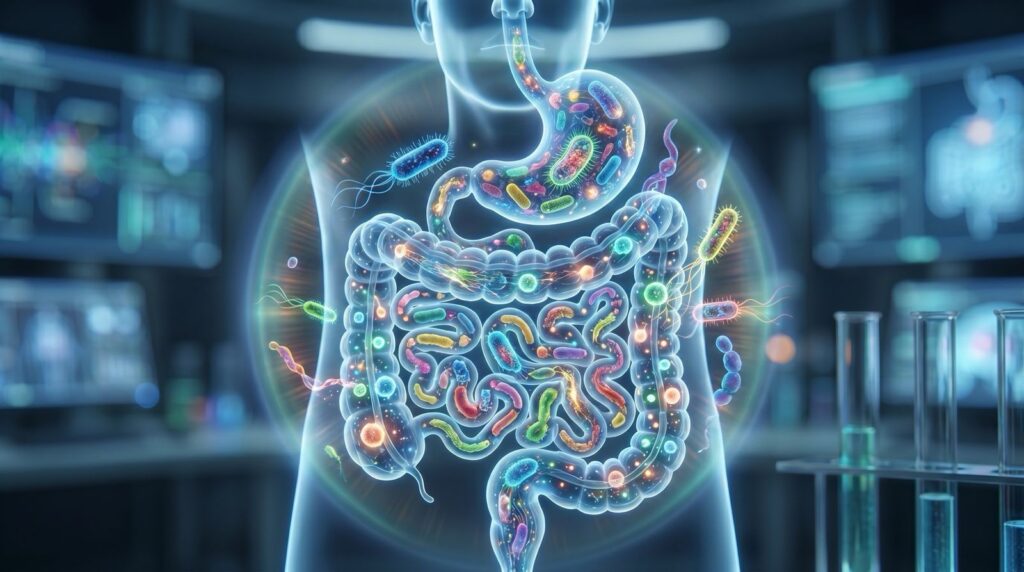 The gastrointestinal tract’s primary barrier function depends on a single layer of epithelial cells held together by protein complexes called tight junctions. When those tight junctions are compromised, by chronic stress, poor diet, antibiotic use, NSAID use, or inflammatory conditions, the gut becomes permeable to bacterial fragments, undigested food particles, and endotoxins that would otherwise remain contained within the intestinal lumen. This is the mechanism underlying what is commonly referred to as leaky gut, and it has increasingly been recognised as a driver of systemic inflammation rather than a purely local digestive problem.
BPC-157’s most consistent finding in gastrointestinal research is its apparent ability to enhance tight junction integrity. In preclinical models, administration of BPC-157 has been associated with upregulation of tight junction proteins, effectively reinforcing the epithelial barrier and reducing the translocation of luminal contents into systemic circulation. This mechanism has been studied across multiple models of gut injury including chemically induced colitis, NSAID-induced mucosal damage, and surgical anastomosis repair.
In inflammatory bowel disease models specifically, BPC-157 has been shown to reduce inflammatory markers, decrease lesion size, and support the regeneration of damaged epithelial tissue. The anti-inflammatory effects observed appear to operate through multiple pathways simultaneously, including modulation of nitric oxide synthesis and suppression of pro-inflammatory cytokine activity, rather than through a single mechanism.
NSAID Protection: One of the Most Studied Applications
One of the more practically relevant areas of BPC-157 gut research involves its apparent protective effects against NSAID-induced gastrointestinal damage. Non-steroidal anti-inflammatory drugs are among the most widely used compounds globally, and their gastrointestinal side effects, gastric ulcers, intestinal lesions, mucosal erosion, represent a significant clinical problem.
NSAIDs damage the gut lining primarily by inhibiting prostaglandin synthesis, which is essential for maintaining the mucus layer that protects the stomach wall. In animal models, BPC-157 has consistently demonstrated the ability to counteract this damage, promoting ulcer healing and mucosal recovery through mechanisms that include stimulation of tissue granulation, angiogenesis at the site of injury, and upregulation of growth factor receptors involved in epithelial repair.
This body of research is among the most replicated in the BPC-157 literature, spanning multiple research groups and animal models over more than two decades. It represents the kind of consistent preclinical signal that makes a compound worth continued serious study.
The Gut-Brain Axis: An Emerging Area of BPC-157 Research
One of the more compelling directions in current BPC-157 research involves the gut-brain axis, the bidirectional communication network between the enteric nervous system and the central nervous system. The gut and the brain communicate continuously through neural, hormonal, and immune pathways, and disruption of gut integrity has been increasingly linked to neurological and psychological outcomes in preclinical research.
BPC-157’s influence on this system appears to operate through its effect on the vagus nerve, the primary neural highway connecting the gut and the brain, as well as through its modulation of serotonin and dopamine pathways that originate partly in the gastrointestinal tract. In animal models, BPC-157 has demonstrated effects on stress responses and mood-related behaviour that researchers have attributed in part to its gut-brain signalling activity. While this remains an earlier-stage area of research compared to the direct gastrointestinal data, it adds a meaningful dimension to understanding why a compound with gut origins might produce effects that extend into neurological and systemic recovery territory.
Beyond the Gut: Why BPC-157’s Recovery Profile Is Broader Than It First Appears
The mechanisms that make BPC-157 relevant to gut health, angiogenesis promotion, tight junction support, growth factor upregulation, nitric oxide pathway modulation, and anti-inflammatory signalling, are not gastrointestinal-specific. They operate across tissue types, which is why the compound’s research applications extend well beyond the digestive system. The three most active areas of non-gastrointestinal BPC-157 research reflect this directly:
-
- Musculoskeletal repair: BPC-157 has been studied for tendon and ligament recovery, where its ability to stimulate fibroblast activity and upregulate growth hormone receptors on connective tissue cells appears to accelerate structural rebuilding at sites of injury.
-
- Vascular regeneration: Its angiogenic properties have been studied for their role in restoring blood supply to damaged tissue, a mechanism that underpins its relevance across multiple injury types regardless of location.
-
- Neurological research: Nitric oxide pathway modulation has been examined in the context of neuroprotection and nerve repair, connecting the compound’s gut-origin mechanisms to central nervous system research applications.
The thread connecting all three is the same regenerative signalling profile that makes BPC-157 effective in gut models. It is not a compound that does one thing well. It is a compound whose mechanisms happen to be relevant across multiple tissue types that share common repair biology. That breadth is why it has accumulated one of the largest preclinical research bases of any synthetic peptide currently in study, and why it consistently ranks as the most searched research peptide in the Canadian market.
BPC-157 is available through Northern Peptides for researchers studying its gastrointestinal, musculoskeletal, and systemic regenerative applications. It sits within the broader Recovery peptides category alongside TB-500, which is frequently studied in combination with BPC-157 for researchers interested in multi-pathway repair protocols. The BPC-157 + TB-500 blend is available for researchers studying that combination directly.
The State of the Evidence
It’s important to be clear about where the research currently stands. The vast majority of BPC-157’s gastrointestinal and regenerative data comes from animal models and in vitro studies. Human clinical trial data remains limited, and the compound has not been approved by Health Canada or any equivalent regulatory body for therapeutic use. The preclinical evidence is extensive and mechanistically well-characterised, but the translation to human clinical outcomes has not yet been formally established through large-scale controlled trials.
This does not diminish the research value of the compound. It means that BPC-157 sits exactly where many of the most interesting research peptides currently sit: a well-developed preclinical picture with a plausible mechanism, waiting for the human data to catch up. For researchers, that gap between preclinical evidence and clinical validation is precisely the territory worth investigating.
All products available through Northern Peptides are sold strictly for research purposes only. Nothing in this article constitutes medical advice, and no compound referenced here is approved by Health Canada for human therapeutic use. Researchers are responsible for ensuring their use of any compound complies with applicable laws and institutional guidelines.