
Retatrutide: The Trillion Dollar Drug, Explained

Something significant happened in the pharmaceutical world last week. Eli Lilly became the first drug company in history to be valued at one trillion dollars. That milestone did not happen because of a single product already on shelves. It happened largely because of what is coming — and at the centre of that story is Retatrutide, a compound that has been quietly building one of the most compelling clinical profiles in modern pharmaceutical research.
For the peptide research community, the news carries a specific kind of weight. Retatrutide is not a novel concept to researchers who have been following the incretin class closely. What the past two weeks have confirmed is that the mainstream world is now paying the same attention, and the Phase 3 data driving that attention is worth examining carefully.
The TRIUMPH-1 Results: What Actually Happened
On May 21, 2026, Eli Lilly released the primary results from TRIUMPH-1, the first of eight Phase 3 trials evaluating Retatrutide across obesity and metabolic disease applications. The results were striking by any measure in this category.
Participants taking the 12mg dose lost an average of 28.3% of their body weight over 80 weeks — equivalent to approximately 70 pounds from an average starting weight. Nearly half of all participants in that dosing group achieved 30% or greater weight loss, a threshold that has historically been associated exclusively with bariatric surgery. No pharmacological intervention had previously reached that benchmark in a controlled trial of this scale.
The results landed at a moment when the obesity drug market was already being described as the most commercially significant pharmaceutical category in a generation. Retatrutide’s TRIUMPH-1 data didn’t just confirm expectations — it exceeded them, and the market responded accordingly.
Why These Numbers Matter Beyond the Headlines
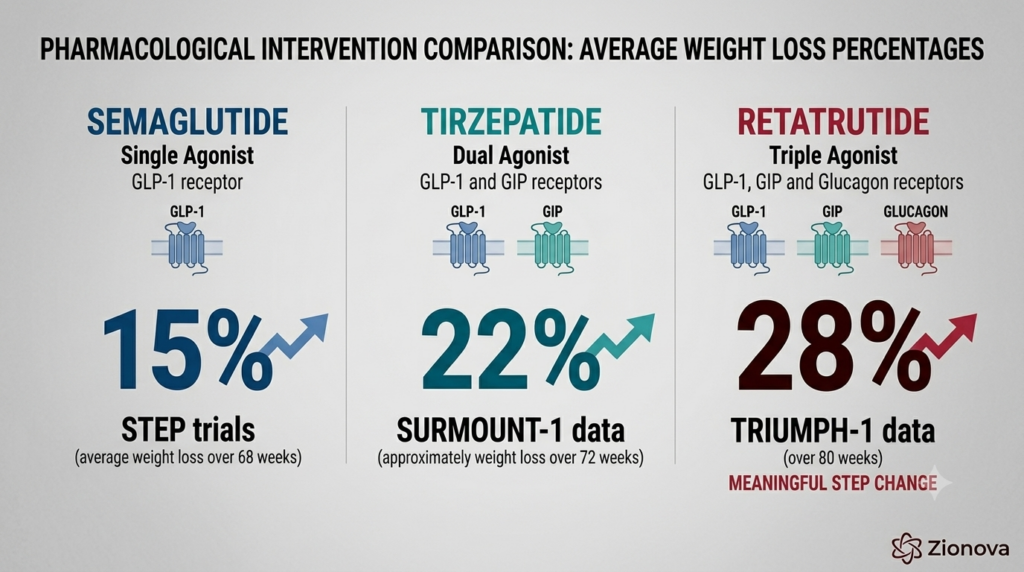 The 28% figure is significant in isolation, but its full meaning only becomes clear when placed alongside the compounds that came before it. Semaglutide’s landmark STEP trials produced average weight loss of around 15% over 68 weeks. Tirzepatide’s SURMOUNT-1 data showed approximately 22% over 72 weeks. Retatrutide’s 28% over 80 weeks represents not just an incremental improvement but a meaningful step change in what pharmacological intervention appears capable of achieving in this space.
The reason for that step change sits in the mechanism. As covered in the Northern Peptides breakdown of how Semaglutide, Tirzepatide, and Retatrutide differ, Retatrutide is a triple agonist engaging GLP-1, GIP, and glucagon receptors simultaneously. The glucagon receptor component, which neither of the earlier compounds activates, appears to contribute meaningfully to energy expenditure and hepatic fat oxidation in ways that extend the metabolic effect beyond appetite suppression alone. The TRIUMPH-1 data is the clearest clinical confirmation yet that the triple receptor mechanism produces outcomes the dual and single agonist compounds cannot match.
The Trillion Dollar Context
Eli Lilly’s trillion dollar valuation is not simply a reflection of current revenue. It is a market projection of what Retatrutide’s commercial potential represents if the remaining seven Phase 3 trials confirm the TRIUMPH-1 signal across broader indications. Those trials cover type 2 diabetes, cardiovascular outcomes, chronic kidney disease, sleep apnea, and liver disease — a breadth of application that reflects how far the research community’s understanding of incretin-based mechanisms has evolved.
Industry analysts have projected Retatrutide revenues of approximately $30 billion by 2031 alone, with the global obesity drug market forecast to reach $150 billion by 2035. Those are figures that explain a trillion dollar valuation more clearly than any single trial result could on its own.
For context, Semaglutide’s commercial trajectory — from research compound to the most prescribed drug in several major markets within a few years of approval — established the template. Retatrutide’s clinical profile suggests its ceiling may be considerably higher.
What TRIUMPH-1 Also Showed Beyond Weight Loss
The weight loss headline has dominated coverage, but TRIUMPH-1 produced cardiometabolic data that deserves equal attention from a research perspective. Participants showed meaningful improvements across blood pressure, triglyceride levels, fasting glucose, and inflammatory markers alongside the weight reduction outcomes.
Separately, TRIUMPH-4 data released earlier in 2026 showed Retatrutide producing significant reductions in knee osteoarthritis pain alongside its weight loss effects, with more than one in eight treated participants reporting complete freedom from knee pain by the end of the trial. That finding extends the research relevance of the compound well beyond metabolic applications and signals why seven additional Phase 3 readouts across different indications are expected through the remainder of the year.
For a deeper look at the cardiovascular dimension of Retatrutide’s research profile specifically, the Northern Peptides blog covers Retatrutide and cardiovascular health in detail.
FDA Approval and What Comes Next
Retatrutide does not yet have FDA approval. Eli Lilly has not submitted a New Drug Application, and the regulatory timeline currently points toward a potential approval window in late 2026 or into 2027, contingent on the remaining Phase 3 readouts. Health Canada approval would follow its own separate review process thereafter.
What the TRIUMPH-1 results do is substantially strengthen the case for that application. Regulators evaluating a compound that produces bariatric surgery-level weight loss outcomes in a controlled pharmacological setting, with a cardiometabolic safety and efficacy profile that appears favourable across multiple markers, are reviewing a dataset that is difficult to argue against on clinical grounds alone.
For Canadian researchers currently studying Retatrutide, the practical landscape has not changed as a result of TRIUMPH-1. The compound remains available for research purposes through Northern Peptides in 10mg, 15mg, and 20mg formats, sitting alongside Tirzepatide and OZ10 Semaglutide within the Fat Loss peptides category for researchers studying the incretin class comparatively.
Why This Moment Matters for the Research Community
The trillion dollar valuation and the TRIUMPH-1 results together represent something beyond a news cycle. They mark the point at which a compound that the research community has been studying seriously for several years has entered mainstream public consciousness at scale. That shift brings increased scrutiny, increased demand, and increased importance of sourcing quality and research rigour.
Researchers who have been working with Retatrutide ahead of this moment are in the strongest position to contextualise the clinical data as it emerges. The seven remaining Phase 3 readouts expected through 2026 will each add to a picture that is already the most compelling in the incretin class. For Canadian researchers, staying close to that data as it develops is precisely what this period of the compound’s history is for.
All products available through Northern Peptides are sold strictly for research purposes only. Nothing in this article constitutes medical advice, and no compound referenced here is approved by Health Canada for human therapeutic use. Researchers are responsible for ensuring their use of any compound complies with applicable laws and institutional guidelines.